

MD&A · 2025
In this section3 topics
Overview of Operations
Overview of Operations
2025 Financial Highlights
Revenue
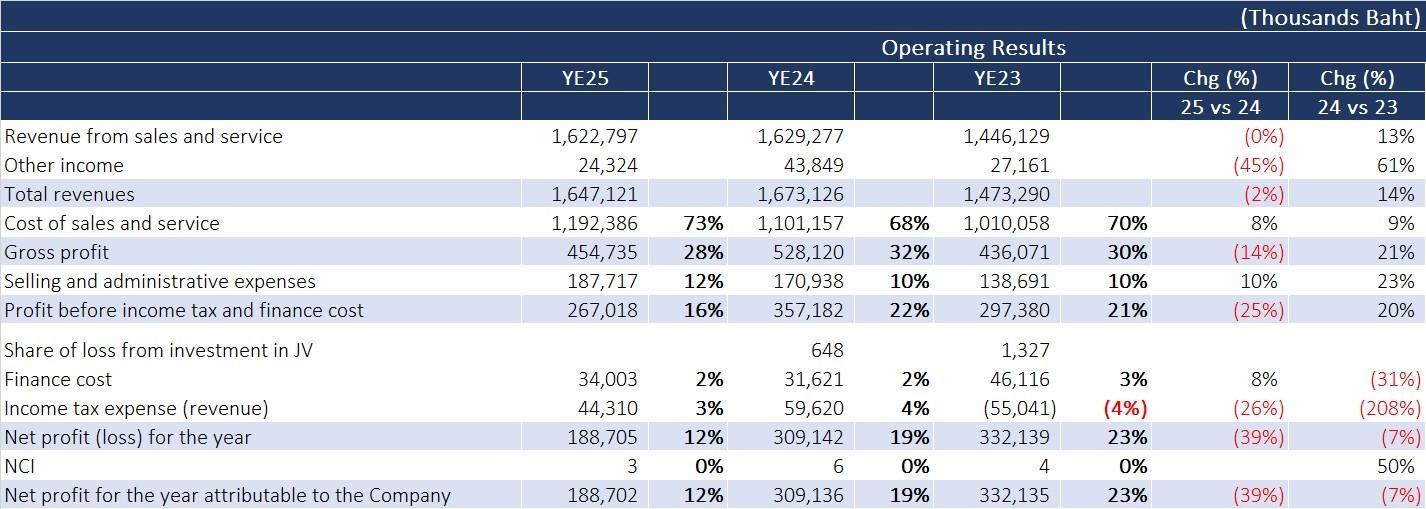
The Company and subsidiaries had total revenue in 2025 of 1,647.12 million baht, a decrease of 26.00 million baht from the same period last year (or a decrease of 1.55%). The big proportion of revenue came from the spa business, which accounted to 89% of the total revenue.
As of 31 December 2025, Siam Wellness Group Public Company Limited had a total of 91 branches (89 domestic branches and 2 overseas branches). There were 14 Newly opened Branches and 1 Branch closure. [As of 31 December 2024, the Company had a total of 76 domestic branches and 2 overseas branches.
2025 Revenue Overview
Revenue Analysis by Business Segment
Siam Wellness Group Public Co., Ltd. (“SWG”), the operator of Spa Business, reported revenue drop of 0.5% of total revenue.
Siam Wellness Resort Co., Ltd. (“SWR”), the operator of RarinJinda Wellness Spa Resort Chiang Mai, Deck One Restaurant Chiang Mai and OHB Cafe in Chiang Mai, Pattaya, Nongkhai and Bangkok, reported revenue growth of 0.5% of total revenue.
Siam Wellness Lab Co., Ltd. (“SWL”), the operator of spa product sales, reported revenue growth of 0.5% of total revenue.
Revenue from existing branches decreased by 8% and from new branches increased by 6.5%, compared to total revenue.
Revenue by Locations: Bangkok branches’ revenue increased by 2.5%, while upcountry branches’ revenue decreased by 4%.
Hotel & Restaurant Revenue accounted for 5% of total revenue in 2025.
Spa Product Sales Revenue accounted for 4% of total revenue in 2025.
Cost of Sales and Services
In 2025, the Company and subsidiaries recorded a cost of sales and services of 1,192.39 million baht, accounting for 73.48% of sales and services revenue. This represents an increase of 91.23 million baht from the previous year, equivalent to a 8.28% increase. Despite a slight decline in total revenue, key variable costs—primarily therapist wages—also decreased. However, fixed costs rose following the opening of new branches during the year, driven mainly by rent, utilities, maintenance, and depreciation. This led to a higher cost-of-sales-to-revenue ratio, resulting in a decrease in Gross Profit.
Selling, Administrative Expenses, and Interest Payments
In 2025, the Company and subsidiaries recorded selling, administrative, and interest expenses of 221.72 million baht, accounting for 13.66% of total revenue from sales and services. This represents an increase of 19.16 million baht or 9.46% from the previous year. The increase was primarily driven by higher selling and advertising expenses, staff expenses, and depreciation resulting from the expansion of the headquarters and warehouse. Additionally, interest expenses rose compared to the previous year due to additional borrowings during the period and the application of TFRS 9 regarding financial instruments.
Net Profit
In 2025, the Company and subsidiaries reported a net profit of 188.70 million baht, accounting for 11.63% of total revenue from sales and services. Net profit decreased by 120.43 million baht or 38.96% compared to the previous year. The revenue decline was primarily due to a drop in Chinese tourists, who represent the company’s main international customer base. However, when comparing our performance against the broader tourism industry's downturn in Chinese arrivals, the company managed to mitigate risks effectively by diversifying into other customer segments. Furthermore, net profit margin was impacted by the high base in Q4 of the previous year, which included a THB 11 million income tax benefit from recognized tax loss carryforwards. Consequently, the net profit margin decreased due to lower sales and rising operating expenses associated with branch expansions throughout the year.
Financial Position
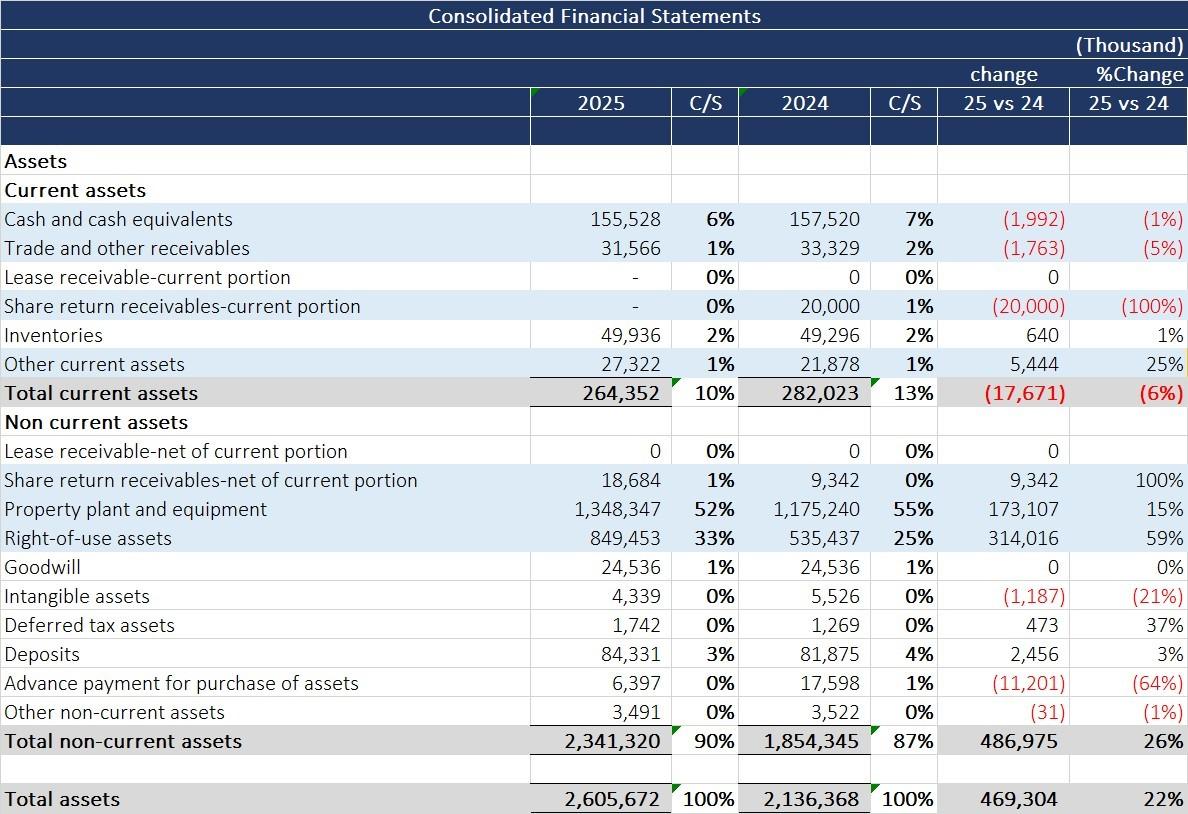
As of December 31, 2025, the Company and its subsidiaries had total assets of THB 2,605.67 million, an increase of THB 469.30 million or 21.97% from 2024. Significant changes are as follows:
Cash and Cash Equivalents decreased from THB 157.20 million to THB 155.53 million (a 1.26% decline). Key activities included cash flow generated from operations, offset by loan and interest repayments, capital expenditure for branch expansions, and dividend payments made during the year.
Trade and Other Receivables decreased from THB 33.33 million in 2024 to THB 31.57 million in 2025 (a 5.29% decline). These arise from ordinary business operations, such as credit terms granted to travel agents, promotional programs with credit card providers, and international franchisees. While most receivables have a maturity of under 3 months, THB 7.92 million has been outstanding for over 12 months. The Company has already recognized an allowance for doubtful accounts for this portion in accordance with its accounting policy and management's assessment.
Share Subscription Receivables amounted to THB 18.68 million, originating from the divestment of shares in Chaba Elegance Co., Ltd. back to the original shareholders. This matter is currently under litigation to recover the payment from the said group.
Property, Plant, and Equipment (PPE) accounts for 52% of total assets, representing a significant portion of the statement of financial position. The value of PPE increased from 2024 due to ongoing branch expansions, net of annual depreciation.
Right-of-Use Assets totaled THB 849.45 million, representing 33% of total assets, resulting from the application of TFRS 16 (Leases), which the Company adopted in 2020.
Liabilities
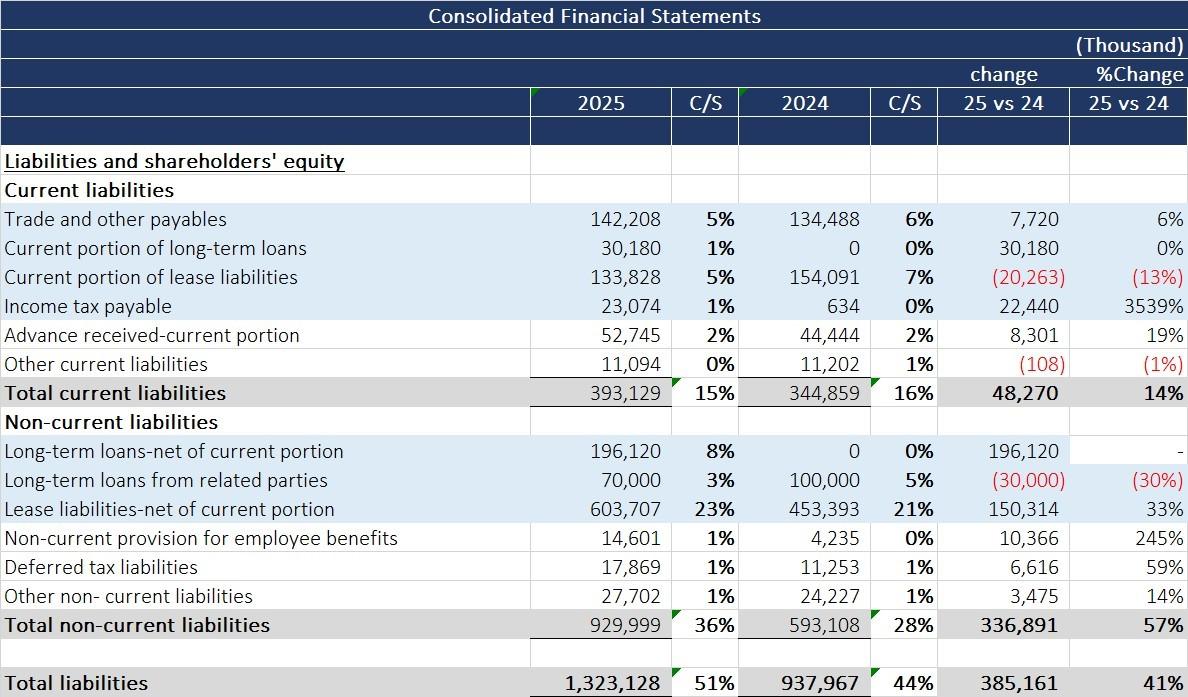
As of December 31, 2025, the Company and its subsidiaries had total liabilities of THB 1,323.13 million, an increase of THB 385.16 million or 41.06% from the previous year. Key components include:
Trade and Other Payables amounted to THB 142.21 million, consisting of obligations incurred in the ordinary course of business. This primarily includes costs for construction and renovation of service outlets, raw materials, and rental expenses.
Long-term Loans: As of year-end 2025, the Company held THB 296.30 million in long-term loans from financial institutions and related parties to fund branch expansions during the year. Loans from financial institutions remain the Company's primary funding source for expansion or liquidity management due to their lower cost of capital compared to other sources—a strategy the Company deems appropriate for the current economic climate.
Lease Liabilities totaling THB 737.54 million (including both current and non-current portions), an increase of THB 130.05 million or 21.41% year-over-year. This rise resulted from new lease agreements entered into during the year, offset by regular repayments and adjustments from contract modifications.
Shareholders' Equity
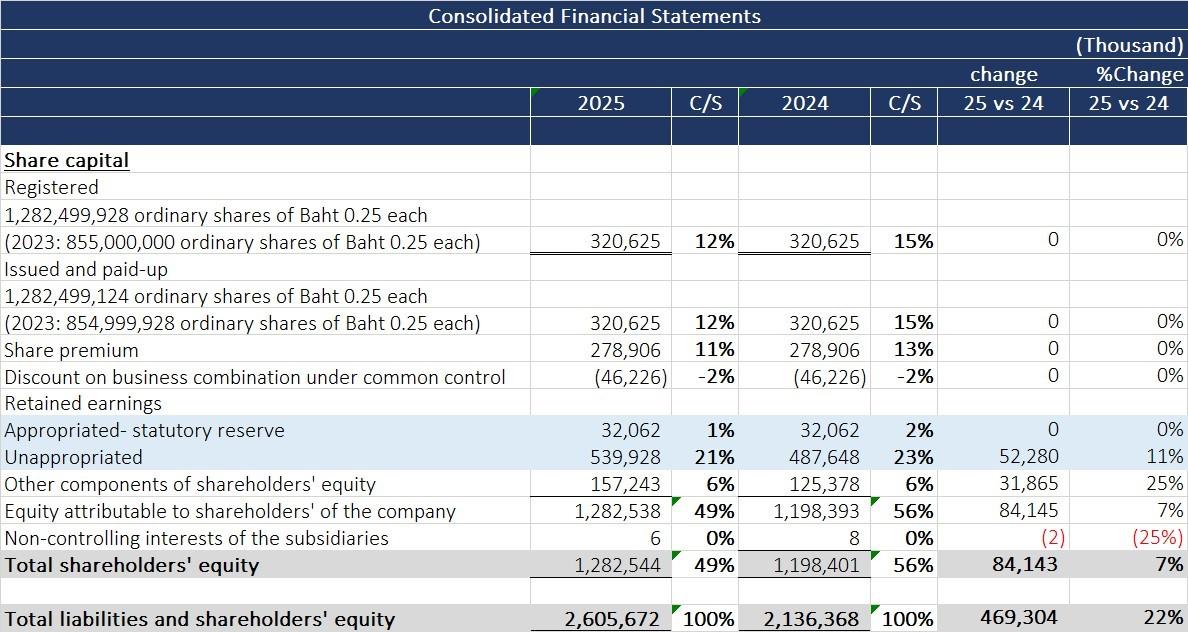
As of December 31, 2025, the Company and subsidiaries had total shareholders' equity of 1,282.54 million baht, an increase of 84.14 million baht or an increase of 7.02% from the previous year. The increase was driven by net profit for 2025 and gains from asset revaluation, which were partially offset by dividend payments and actuarial losses from employee benefit obligations.
Cash Flow Overview
As of December 31, 2025, cash and cash equivalents totaled 155.53 million baht, representing a decrease of 1.99 million baht or 1.26% from the previous year. Key movements included net cash generated from operating activities, which was offset by operating expenses, loan repayments, capital expenditures for branch expansion, and interim dividend payments made during the year.
Key Financial Ratios
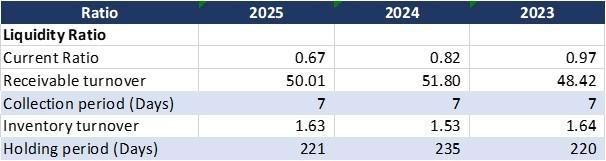
Current Ratio: 0.67, slightly lower than the previous year. If lease liabilities due within one year (133.83 million baht) under TFRS 16 are excluded, the current ratio would be 1.02.
Receivable Turnover & Collection Period: Similar to 2024, reflecting effective receivables management.
Inventory turnover and the average holding period saw a slight decrease in 2025. The holding period remains relatively long due to increased procurement of service-related supplies. These items have a long shelf life, and the Company utilizes bulk purchasing to achieve economies of scale and reduce unit costs
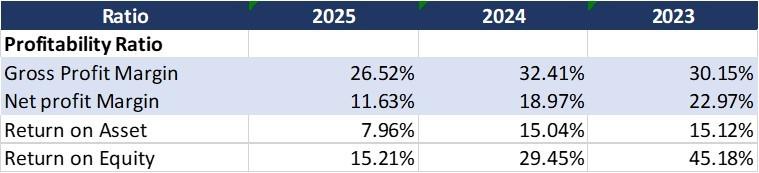
Profitability Ratios declined compared to previous years. The net profit margin contracted year-over-year due to a dip in revenue coupled with rising costs and expenses from branch expansions. Furthermore, the margin shows a significant decrease when compared to 2023; this is primarily because the 2023 figures included a THB 55 million income tax benefit recognized from tax loss carryforwards expected to be utilized.

Debt-to-Equity (D/E) Ratio: In 2025, the D/E ratio rose to 1.03, up from 0.78 in 2024. This increase was primarily driven by additional long-term borrowings and an increase in lease liabilities under TFRS 16. While shareholders' equity grew due to 2025 net profits, the growth rate was lower than that of the rising liabilities. Notably, if lease liabilities of THB 737.54 million (both current and non-current) are excluded, the D/E ratio would stand at a much lower 0.46.
Interest Coverage Ratio: The ratio for 2025 was 7.85, a decrease from the previous year. This decline resulted from a combination of softened net profit and higher finance costs associated with the new long-term loans secured during the period.
Sustainability Policy and Goals
SPA has established a Sustainability Policy and Goals to serve as a guideline for implementing business strategies aimed at achieving stable and sustainable growth across all dimensions—economy, society, and the environment. This involves integrating the concept of sustainable development into every core function by elevating the importance of sustainability throughout the entire Value Chain. There is a focus on adding value to activities within the process of providing services and selling products (In-process Activities). Additionally, emphasis is placed on prioritizing stakeholders. The Working Group, operating under the supervision of the Corporate Governance Committee, serves as the creator of the Implementation Guidelines. This group lays out the framework and goals to drive sustainability in three key areas:
Economic Development/Regulatory | Social Development | Environmental Development |
|
|
|
Economic/Regulatory Dimension | Policy |
Customer health and safety | Focus on creating an establishment that is hygienic and safe for customers by enhancing customer hygiene and safety measures to be in line with the current situation under the measure “A Place you can trust” |
Enterprise Risk Management | Focus on building the organization for sustainable growth, regularly assess organizational risks with information, analyze and track the situation closely |
Cyber Security and Personal Data Protection | Focus on creating an organization with cyber security and protection of personal information. PDPA Working group monitors and updates cybersecurity and personal information protection in accordance with the law and policy of practice. |
Structural Policy and Corporate Governance | Focus on building an organization to be able to operate under a stable organizational structure. Focus on all stakeholders by adhering to the good corporate governance policy |
Social dimension | Policy |
Customer responsibility | Focus on creating an establishment that is responsible to customers throughout the process by focusing on providing a standard service, friendly service, clean, hygienic place, reasonable price. Gives importance to safety and customer privacy. |
Providing access to treatment and good health | Focus on building an organization that cares about the health of employees and staff. Coverage of health benefits as staff benefits and building a great workplace for employees. |
Local Employment, including people with disabilities and underprivileged individuals. | Focus on hiring local personnel to increase skills, knowledge, expertise which can be extended to community development |
Providing access to information | Focus on creating an organization that provides equal access to information. for complete work and judgment |
Environmental Dimension | Policy |
Product Responsibility | Present accurate information about the products and services, deliver a variety of products in order to provide services to customers that meet their needs |
Use of eco-friendly packaging | Focus on creating a corporate culture that cares about the environment. Create quality products and services using packaging that is good for the environment under 3R (Reduce, Reuse, Recycle) |
Waste management | Focus on creating an organizational culture that cares about the environment. Supervise and manage the use of natural resources to achieve maximum benefit. Improve business processes to reduce environmental impact |
Water management policy | Focus on creating an organizational culture that cares about the environment. Supervise and manage the use of natural resources to achieve maximum benefit. Improve business processes to reduce environmental impact |
Debt Securities with Financial Ratio Requirements
Debt Securities with Financial Ratio Requirements Issued?
No
Factors That May Affect Financial Condition
Factors or Incidents That May Materially Affect Financial Condition
Analysis of Factors Affecting Future Operations
1. Economic and Tourism Factors
Tourist Arrivals: The Company’s revenue is directly correlated with the number of tourists visiting Thailand, both domestic and international. Fluctuations in tourist arrivals significantly impact overall revenue.
Seasonality: The spa business is subject to seasonal fluctuations. Performance typically peaks during the High Season, while the Low Season may lead to a temporary slowdown in operational results.
Consumer Purchasing Power: The broader economic climate and consumer spending power influence the decision to utilize spa and wellness services. An economic downturn could lead to reduced consumer spending and impact sales volume.
2. Internal Factors
Strategic Expansion: Opening new branches, both domestically and internationally, remains a core growth strategy. Future analysis will focus on the number of new openings, expansion roadmaps, and their projected impact on revenue and cost structures.
Cost Management: Effective control of operating costs—such as rent, labor, revenue-sharing, and Selling, General, and Administrative (SG&A) expenses—is critical to maintaining gross and net profit margins.
Business Diversification: Expanding into new service lines, such as "Stretch me Clinic," and diversifying into the hotel and restaurant sectors helps broaden revenue streams and mitigates the risk of over-reliance on the core spa business.
Human Resources: The availability of high-quality service personnel is vital. Labor shortages, particularly of skilled massage therapists, represent a key operational risk that requires proactive management.
3. Competitive Factors
Market Competition: The spa industry is highly competitive, facing pressure from both direct competitors and substitute wellness services. The Company continuously refines its competitive strategies to maintain market leadership and brand positioning.